python读写csv文件的方法
1.爬取豆瓣top250书籍
import requests
import json
import csv
from bs4 import BeautifulSoup
books = []
def book_name(url):
 res = requests.get(url)
 html = res.text
 soup = BeautifulSoup(html, 'html.parser')
 items = soup.find(class_="grid-16-8 clearfix").find(class_="indent").find_all('table')
 for i in items:
  book = []
  title = i.find(class_="pl2").find('a')
  book.append('《' + title.text.replace(' ', '').replace('\n', '') + '》')
  star = i.find(class_="star clearfix").find(class_="rating_nums")
  book.append(star.text + '分')
  try:
   brief = i.find(class_="quote").find(class_="inq")
  except AttributeError:
   book.append('”暂无简介“')
  else:
   book.append(brief.text)
  link = i.find(class_="pl2").find('a')['href']
  book.append(link)
  global books
  books.append(book)
  print(book)
 try:
  next = soup.find(class_="paginator").find(class_="next").find('a')['href']
 # 翻到最后一页
 except TypeError:
  return 0
 else:
  return next
next = 'https://book.douban.com/top250?start=0&filter='
count = 0
while next != 0:
 count += 1
 next = book_name(next)
 print('-----------以上是第' + str(count) + '页的内容-----------')
csv_file = open('D:/top250_books.csv', 'w', newline='', encoding='utf-8')
w = csv.writer(csv_file)
w.writerow(['书名', '评分', '简介', '链接'])
for b in books:
 w.writerow(b)
结果
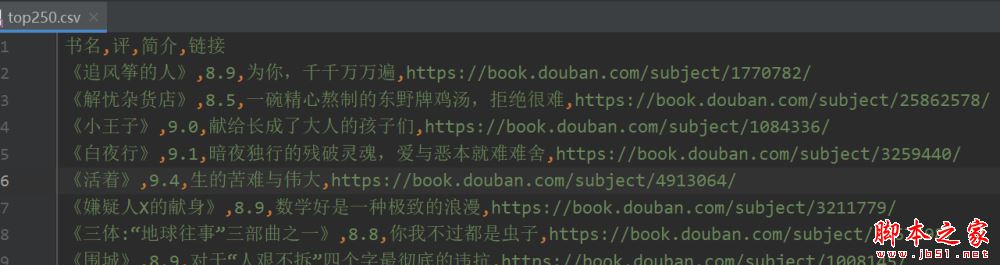
2.把评分为9.0的书籍保存到book_out.csv文件中
'''
1.爬取豆瓣评分排行前250本书,保存为top250.csv
2.读取top250.csv文件,把评分为9.0以上的书籍保存到另外一个csv文件中
'''
import csv
#打开的时候必须用encoding='utf-8',否则报错
with open('top250.csv', encoding='utf-8') as rf:
 reader = csv.reader(rf)
 #读取头部
 headers = next(reader)
 with open('books_out.csv', 'w', encoding='utf-8') as wf:
  writer = csv.writer(wf)
  #把头部信息写进去
  writer.writerow(headers)
  for book in reader:
   #获取评分
   score = book[1]
   #把评分大于9.0的过滤出来
   if score and float(score) >= 9.0:
    writer.writerow(book)
总结
以上所述是小编给大家介绍的python读写csv文件的方法,希望对大家有所帮助,如果大家有任何疑问请给我留言,小编会及时回复大家的。在此也非常感谢大家对【听图阁-专注于Python设计】网站的支持!
如果你觉得本文对你有帮助,欢迎转载,烦请注明出处,谢谢!