Python文件和目录操作详解
一、文件的打开和创建
1、打开
open(file,mode):
>>>fo = open('test.txt', 'r')
>>>fo.read()
'hello\n'
>>>fo.close()
file(file,mode):
>>>f = file('test.txt', 'r')
>>>f.read()
'hello\n'
>>>f.close()
mode可取值:
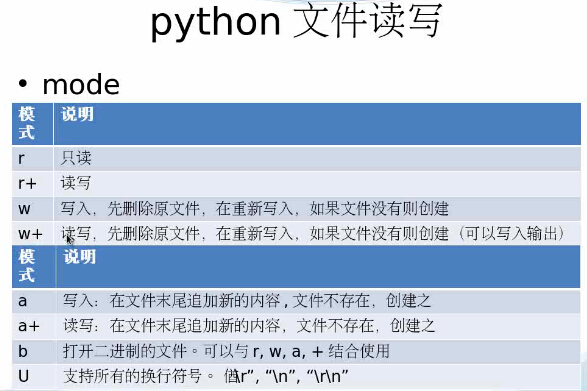
2、创建
用w/w+/a/a+模式打开即可。
二、文件的读取
1、String = FileObject.read([size])
>>> fr = open('test.txt')
>>> fr.read()
'hello\nworld\n'
or:
>>> for i in open('test.txt'):
... print i
...
hello
world
2、String = FileObject.readline([size])
>>> f = open('test.txt')
>>> f.readline()
'hello\n'
>>> f.readline()
'world\n'
>>> f.readline()
''
或者可以用next
3、List = FileObject.readlines([size])
>>> f = open('test.txt')
>>> f.readlines()
['hello\n', 'world\n']
三、文件的写入
1、write(string)
>>> f = open('test.txt', 'a')
>>> f.write('hello\nworld')
#'hello\nworld'
2、writelines(list)
>>> l = ['a','b','c']
>>> f=open('test.txt','a')
>>> f.writelines(l)
#'hello\nworldabc'
注:writelines相当于调用了多次write,不会自动添加换行(\n)符
四、内容查找替换
1、FileObject.seek(offset, mode)
offset:偏移量
mode:
0表示将文件指针指向从文件头部到“偏移量”字节处,
1表示将文件指针指向从文件当前位置向后移动“偏移量”字节,
2表示将文件指针指向从文件尾部向前移动“偏移量”字节。
>>> f=open('test.txt')
>>> f.read()
'hello\nworldabc'
>>> f.read()
''
>>> f.seek(0,0)
>>> f.read()
'hello\nworldabc'
>>> f.close()
2、flush:提交更新,即在文件关闭之前把内存中的内容强制写入文件(一般是文件关闭后写入)
3、文件查找:遍历行进行查找
#!/usr/bin/python
import re
search='hello world'
file='test.txt'
count = 0
f = open(file)
for l in f.readlines():
li = re.findall(search,l)
if len(li) > 0:
count += len(li)
print "Search " + str(count) + " \"" + search + "\""
f.close()
4、文件内容替换:遍历行进行替换
替换到新文件demo:
#!/usr/bin/python
os='hello'
of='test.txt'
rs='ten'
rf='test2.txt'
ofh = open(of)
newl=[]
for l in ofh.readlines():
nl = l.replace(os,rs)
newl.append(nl)
rfh = open(rf,'w+')
rfh.writelines(newl)
ofh.close()
rfh.close()
替换到原文件demo:
[server@localserver file]$ cat test.txt
abc
hello
world
hello world
helloworld
hello hello world
[server@localserver file]$ cat fr.py
#!/usr/bin/python
os='hello'
file='test.txt'
rs='ten'
f = open(file, 'r+')
s=f.read()
f.seek(0,0)
f.close()
f = open(file, 'w+')
f.write(s.replace(os,rs))
f.close()
[server@localserver file] python fr.py
[server@localserver file]$ cat test.txt
abc
ten
world
ten world
tenworld
ten ten world
这里采用了重建文件的办法。
或用 fileinput 模块直接在原文件上修改:
#!/usr/bin/python
import fileinput
os='hello'
file='test.txt'
rs='ten'
for line in fileinput.input(file, inplace=True):
print line.replace(os,rs).replace('\n','')
注意,这里删除了\n是因为print时会写入换行。
五、文件及目录操作
一般是借助OS模块实现
1、mkdir(path[,mode=0777]):创建目录,相当于mkdir
>>>import os
>>>os.mkdir('tt')
2、makedirs(name[, mode=511]):创建多级目录,相当于mkdir -p
3、rmdir(path):删除目录,相当于rm
4、removedirs(path):删除多级目录,相当于rm -rf
5、listdir(path):列出目录中文件和文件夹,相当于ls
6、getcwd():获取当前路径,相当于pwd
7、chdir(path):切换目录,相当于cd
8、rename(src, dst):重命名
9、shutil.copyfile(str,dst):复制文件(要引入shutil模块)
10、path.splitext(filename):获取文件路径和扩展名
>>> import os
>>> fileName, fileExtension = os.path.splitext('/path/to/somefile.ext')
>>> fileName
'/path/to/somefile'
>>> fileExtension
'.ext'
11、walk(top, topdown=True, onerror=None):遍历目录
>>> import os
>>> g = os.walk('a')
>>> g.next()
('a', ['b'], [])
>>> g.next()
('a/b', ['f', 'c'], [])
>>> g.next()
('a/b/f', [], ['3.txt'])
>>> g.next()
('a/b/c', ['d', 'e'], [])
>>> g.next()
('a/b/c/d', [], ['1.txt'])
>>> g.next()
('a/b/c/e', [], ['2.txt'])
walk返回的是一个生成器,生成器中的内容是:当前目录,目录列表,文件列表
python自己递归实现文件遍历:
#!/usr/bin/python
import os
def dirList(path):
filelist = os.listdir(path)
fpath = os.getcwd()
allfile = []
for filename in filelist:
filepath = os.path.abspath(os.path.join(path, filename))
if os.path.isdir(filepath):
allfile.extend(dirList(filepath))
else:
allfile.append(filepath)
return allfile
files = dirList('a')
print files