使用python和pygame制作挡板弹球游戏
python是个很有趣的语言,可以在cmd命令窗口运行,还有很多的功能强大的模块。
学了一天pygame,用python和pygame写一个简单的挡板弹球游戏。
2018年6月21日 00:15:21
GitHub:
# -*- coding:utf-8 -*-
from sys import exit
import pygame
from pygame.locals import *
pygame.init()
# 创建窗口
ScreenWidth = 500
ScreenHright = 720
ScreenSize = (ScreenWidth, ScreenHright)
Screen = pygame.display.set_mode(ScreenSize, 0, 32)
pygame.display.set_caption("Ly's Easy Ball Game")
# 背景音乐
pygame.mixer.music.load('Sugar.mp3')
pygame.mixer.music.play(-1, 0.0)
# 碰撞音效
CollisionMusic = pygame.mixer.Sound('collision.wav')
# 重新开始按钮音效
ButtonMusic = pygame.mixer.Sound('button.wav')
# 游戏结束音效
GameOverMusic = pygame.mixer.Sound('over.wav')
def GameStart():
  # 游戏背景Surface对象
  Background = pygame.image.load('GameBackground.jpg').convert()
  # 挡板Surface对象
  Baffle = pygame.image.load('Baffle.png').convert_alpha()
  # 球Surface对象
  Ball = pygame.image.load('Ball.png').convert_alpha()
  # 挡板位置信息
  BaffleX = 140
  BaffleY = 600
  BaffleSpeed = 1000
  BaffleXSpeed = BaffleSpeed
  BaffleYSpeed = BaffleSpeed
  BaffleMove = {K_LEFT: 0, K_RIGHT: 0, K_UP: 0, K_DOWN: 0}
  # 球位置信息
  BallX = 235
  BallY = 0
  BallSpeed = 1000.
  BallXSpeed = BallSpeed
  BallYSpeed = BallSpeed
  # 帧率控制Clock对象
  FPSClock = pygame.time.Clock()
  # 时间显示Clock对象
  ProgramRunClock = pygame.time.get_ticks()
  # 时间显示Font对象
  RunTimeFont = pygame.font.Font('Jura-DemiBold.ttf', 24)
  # 游戏结果
  GameResult = ''
  while True:
    # 接收信息处理
    for event in pygame.event.get():
      if event.type == QUIT:
        exit()
      if event.type == KEYDOWN:
        if event.key in BaffleMove:
          BaffleMove[event.key] = 1
      elif event.type == KEYUP:
        if event.key in BaffleMove:
          BaffleMove[event.key] = 0
    # 绘制背景
    Screen.blit(Background, (0, 0))
    RunTimeStr = str((pygame.time.get_ticks() - ProgramRunClock) / 1000.0)
    # print(RunTimeStr)
    # 使用render方法显示时间字体
    RunTimeSurface = RunTimeFont.render(RunTimeStr, True, (255, 52, 179))
    # 显示时间
    Screen.blit(RunTimeSurface, (0, 0))
    # 距上次调用clock对象时间
    SecondTimePassed = FPSClock.tick(60) / 1000.0
    # 绘制球
    Screen.blit(Ball, (BallX, BallY))
    BallX += BallXSpeed * SecondTimePassed
    BallY += BallYSpeed * SecondTimePassed
    # 判断球边界条件
    if BallX > 500 - Ball.get_width():
      BallXSpeed = -BallXSpeed
      BallX = 500 - Ball.get_width()
    elif BallX < 0:
      BallXSpeed = -BallXSpeed
      BallX = 0
    if BallY > 720 - Ball.get_width():
      BallYSpeed = -BallYSpeed
      BallY = 720 - Ball.get_width()
    elif BallY < 0:
      BallYSpeed = -BallYSpeed
      BallY = 0
    # 定位挡板移动后坐标
    BaffleX -= BaffleMove[K_LEFT] * BaffleXSpeed * SecondTimePassed
    BaffleX += BaffleMove[K_RIGHT] * BaffleXSpeed * SecondTimePassed
    BaffleY -= BaffleMove[K_UP] * BaffleYSpeed * SecondTimePassed
    BaffleY += BaffleMove[K_DOWN] * BaffleYSpeed * SecondTimePassed
    # 判断挡板边界条件
    if BaffleX > 500 - Baffle.get_width():
      BaffleX = 500 - Baffle.get_width()
    elif BaffleX < 0:
      BaffleX = 0
    if BaffleY > 720 - 45 - Baffle.get_height():
      BaffleY = 720 - 45 - Baffle.get_height()
    elif BaffleY < 720 - Baffle.get_height() * 3:
      BaffleY = 720 - Baffle.get_height() * 3
    # 绘制挡板
    Screen.blit(Baffle, (BaffleX, BaffleY))
    # 判断球碰撞挡板条件
    # 挡板左上角
    if BallX == BaffleX - Ball.get_width() and BallY == BaffleY - Ball.get_height():
      BallXSpeed = -BallXSpeed
      BallYSpeed = -BallYSpeed
      CollisionMusic.play()
    # 挡板左下角
    elif BallX == BaffleX - Ball.get_width() and BallY == BaffleY + Baffle.get_height():
      BallXSpeed = -BallXSpeed
      BallYSpeed = -BallYSpeed
      CollisionMusic.play()
    # 挡板右上角
    elif BallX == BaffleX + Baffle.get_width() and BallY == BaffleY - Ball.get_height():
      BallXSpeed = -BallXSpeed
      BallYSpeed = -BallYSpeed
      CollisionMusic.play()
    # 挡板右下角
    elif BallX == BaffleX + Baffle.get_width() and BallY == BaffleY + Baffle.get_height():
      BallXSpeed = -BallXSpeed
      BallYSpeed = -BallYSpeed
      CollisionMusic.play()
    # 挡板上表面
    elif BallX > BaffleX and BallX < BaffleX + Baffle.get_width() and BallY > BaffleY - Ball.get_height() and BallY < BaffleY:
      BallYSpeed = -BallYSpeed
      BallY = BaffleY - Ball.get_height()
      CollisionMusic.play()
    # 挡板下表面
    elif BallX > BaffleX and BallX < BaffleX + Baffle.get_width() and BallY < BaffleY + Baffle.get_height() and BallY > BaffleY:
      BallYSpeed = -BallYSpeed
      BallY = BaffleY + Baffle.get_height()
      CollisionMusic.play()
    # 挡板左侧面
    elif BallY > BaffleY and BallY < BaffleY + Baffle.get_height() and BallX > BaffleX - Ball.get_width() and BallX < BaffleX:
      BallXSpeed = -BallXSpeed
      BallX = BaffleX
      CollisionMusic.play()
    # 挡板右侧面
    elif BallY > BaffleY and BallY < BaffleY + Baffle.get_height() and BallX > BaffleX + Baffle.get_width() - Ball.get_width() and BallX < BaffleX + Baffle.get_width():
      BallXSpeed = -BallXSpeed
      BallX = BaffleX + Baffle.get_width()
      CollisionMusic.play()
    if BallY > 720 - 45:
      GameResult = RunTimeStr
      GameOverMusic.play()
      return GameResult
    # 刷新显示
    pygame.display.update()
def GameResult(GameResult):
  # 游戏结果背景Surface对象
  GameResultBackground = pygame.image.load('GameResultBackground.png').convert()
  # 游戏结果引导
  ResultHint = pygame.image.load('ResultFont.png').convert_alpha()
  # 游戏结果Font对象
  GameResultFont = pygame.font.Font('EuroBold.ttf', 100)
  # 重新开始按钮
  ReStartButton = pygame.image.load('ReStartButton.png').convert_alpha()
  # 重新开始Hover按钮
  ReStartButtonHover = pygame.image.load('ReStartButtonHover.png').convert_alpha()
  while True:
    for event in pygame.event.get():
      if event.type == QUIT:
        exit()
      if event.type == pygame.MOUSEBUTTONDOWN and 150 <= event.pos[
        0] <= 150 + ReStartButton.get_width() and 450 <= event.pos[1] <= 450 + ReStartButton.get_height():
        ButtonMusic.play()
        return True
    # 游戏结果背景
    Screen.blit(GameResultBackground, (0, 0))
    # 游戏结果引导
    Screen.blit(ResultHint, (45, 200))
    RunTimeSurface = GameResultFont.render(GameResult, True, (255, 69, 0))
    Screen.blit(RunTimeSurface, (90, 270))
    # 重新开始游戏按钮
    MouseX, MouseY = pygame.mouse.get_pos()
    if 150 <= MouseX <= 150 + ReStartButton.get_width() and 450 <= MouseY <= 450 + ReStartButton.get_height():
      Screen.blit(ReStartButtonHover, (150, 450))
    else:
      Screen.blit(ReStartButton, (150, 450))
    # 游戏结果
    pygame.display.update()
if __name__ == '__main__':
  flag = True
  while flag:
    GameResultStr = GameStart()
    if GameResultStr != '':
      flag = GameResult(GameResultStr)
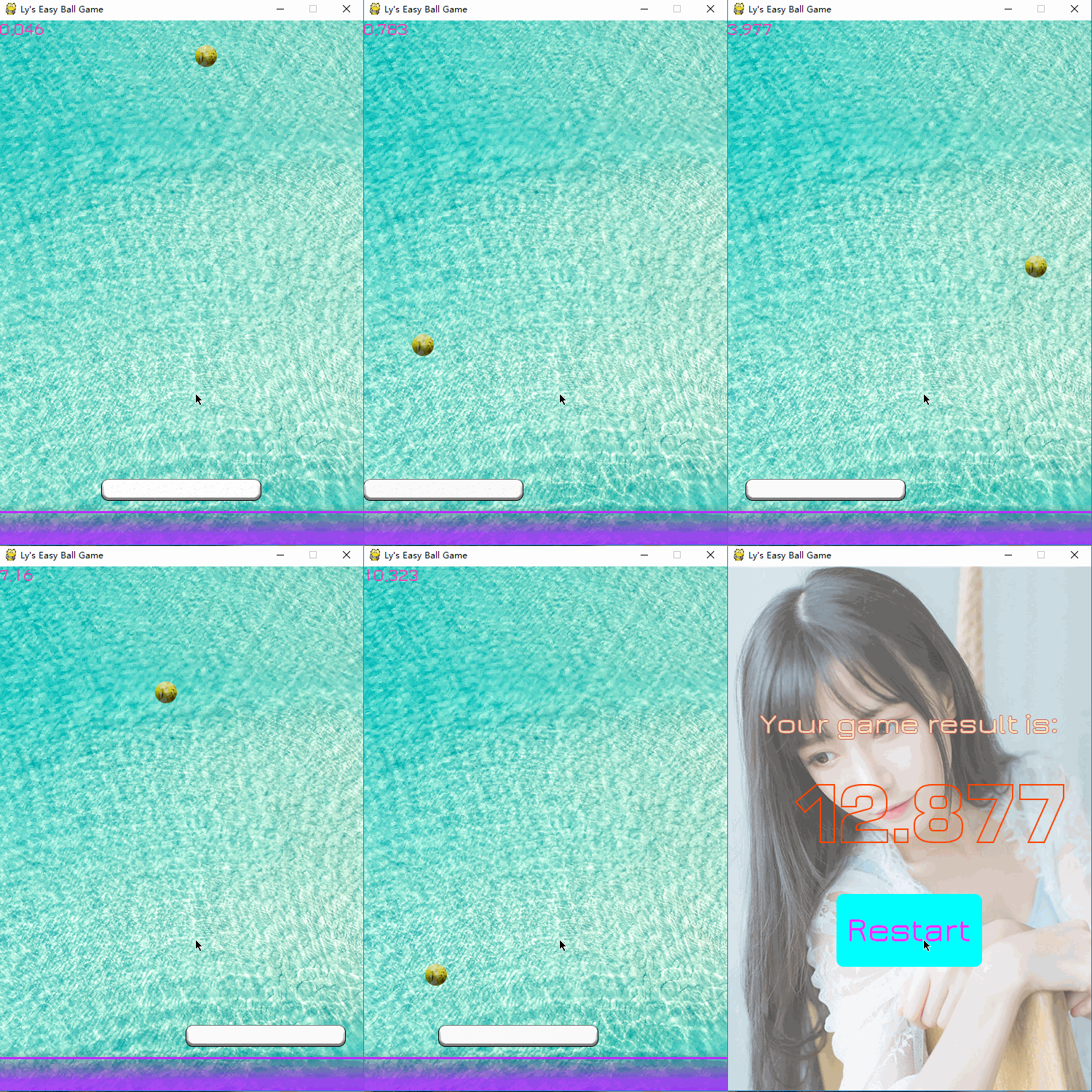
运行结果:
总结
以上所述是小编给大家介绍的用python和pygame制作挡板弹球游戏,希望对大家有所帮助,如果大家有任何疑问请给我留言,小编会及时回复大家的。在此也非常感谢大家对【听图阁-专注于Python设计】网站的支持!
如果你觉得本文对你有帮助,欢迎转载,烦请注明出处,谢谢!