python开发之基于thread线程搜索本地文件的方法
本文实例讲述了python开发之基于thread线程搜索本地文件的方法。分享给大家供大家参考,具体如下:
先来看看运行效果图:
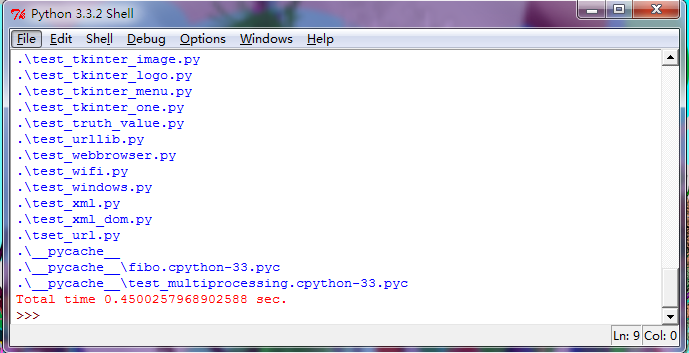
利用多个线程处理搜索的问题,我们可以发现他很快....
下面是代码部分:
# A parallelized "find(1)" using the thread module.
# This demonstrates the use of a work queue and worker threads.
# It really does do more stats/sec when using multiple threads,
# although the improvement is only about 20-30 percent.
# (That was 8 years ago. In 2002, on Linux, I can't measure
# a speedup. :-( )
# I'm too lazy to write a command line parser for the full find(1)
# command line syntax, so the predicate it searches for is wired-in,
# see function selector() below. (It currently searches for files with
# world write permission.)
# Usage: parfind.py [-w nworkers] [directory] ...
# Default nworkers is 4
import sys
import getopt
import time
import os
from stat import *
import _thread as thread
# Work queue class. Usage:
#  wq = WorkQ()
#  wq.addwork(func, (arg1, arg2, ...)) # one or more calls
#  wq.run(nworkers)
# The work is done when wq.run() completes.
# The function calls executed by the workers may add more work.
# Don't use keyboard interrupts!
class WorkQ:
  # Invariants:
  # - busy and work are only modified when mutex is locked
  # - len(work) is the number of jobs ready to be taken
  # - busy is the number of jobs being done
  # - todo is locked iff there is no work and somebody is busy
  def __init__(self):
    self.mutex = thread.allocate()
    self.todo = thread.allocate()
    self.todo.acquire()
    self.work = []
    self.busy = 0
  def addwork(self, func, args):
    job = (func, args)
    self.mutex.acquire()
    self.work.append(job)
    self.mutex.release()
    if len(self.work) == 1:
      self.todo.release()
  def _getwork(self):
    self.todo.acquire()
    self.mutex.acquire()
    if self.busy == 0 and len(self.work) == 0:
      self.mutex.release()
      self.todo.release()
      return None
    job = self.work[0]
    del self.work[0]
    self.busy = self.busy + 1
    self.mutex.release()
    if len(self.work) > 0:
      self.todo.release()
    return job
  def _donework(self):
    self.mutex.acquire()
    self.busy = self.busy - 1
    if self.busy == 0 and len(self.work) == 0:
      self.todo.release()
    self.mutex.release()
  def _worker(self):
    time.sleep(0.00001)   # Let other threads run
    while 1:
      job = self._getwork()
      if not job:
        break
      func, args = job
      func(*args)
      self._donework()
  def run(self, nworkers):
    if not self.work:
      return # Nothing to do
    for i in range(nworkers-1):
      thread.start_new(self._worker, ())
    self._worker()
    self.todo.acquire()
# Main program
def main():
  nworkers = 4
  #print(getopt.getopt(sys.argv[1:], '-w:'))
  opts, args = getopt.getopt(sys.argv[1:], '-w:')
  for opt, arg in opts:
    if opt == '-w':
      nworkers = int(arg)
  if not args:
    #print(os.curdir)
    args = [os.curdir]
  wq = WorkQ()
  for dir in args:
    wq.addwork(find, (dir, selector, wq))
  t1 = time.time()
  wq.run(nworkers)
  t2 = time.time()
  sys.stderr.write('Total time %r sec.\n' % (t2-t1))
# The predicate -- defines what files we look for.
# Feel free to change this to suit your purpose
def selector(dir, name, fullname, stat):
  # Look for world writable files that are not symlinks
  return (stat[ST_MODE] & 0o002) != 0 and not S_ISLNK(stat[ST_MODE])
# The find procedure -- calls wq.addwork() for subdirectories
def find(dir, pred, wq):
  try:
    names = os.listdir(dir)
  except os.error as msg:
    print(repr(dir), ':', msg)
    return
  for name in names:
    if name not in (os.curdir, os.pardir):
      fullname = os.path.join(dir, name)
      try:
        stat = os.lstat(fullname)
      except os.error as msg:
        print(repr(fullname), ':', msg)
        continue
      if pred(dir, name, fullname, stat):
        print(fullname)
      if S_ISDIR(stat[ST_MODE]):
        if not os.path.ismount(fullname):
          wq.addwork(find, (fullname, pred, wq))
# Call the main program
main()
希望本文所述对大家Python程序设计有所帮助。