Python使用Tkinter实现机器人走迷宫
这本是课程的一个作业研究搜索算法,当时研究了一下Tkinter,然后写了个很简单的机器人走迷宫的界面,并且使用了各种搜索算法来进行搜索,如下图:
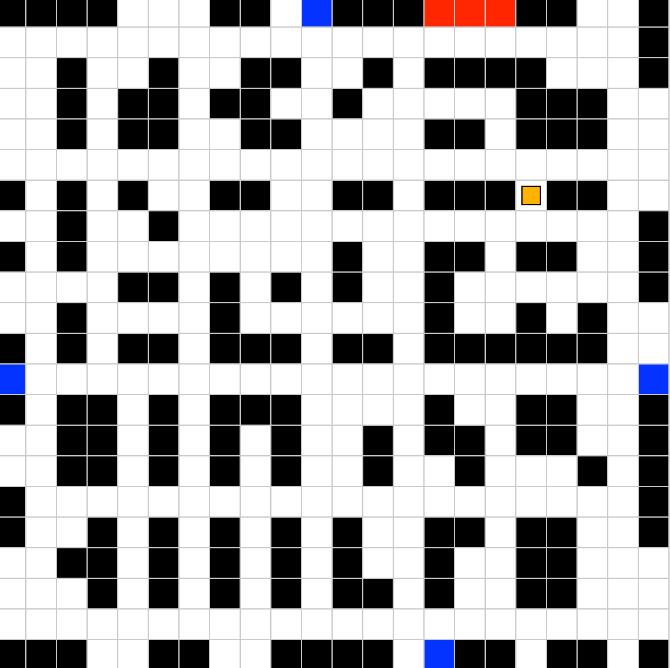
使用A*寻找最优路径:
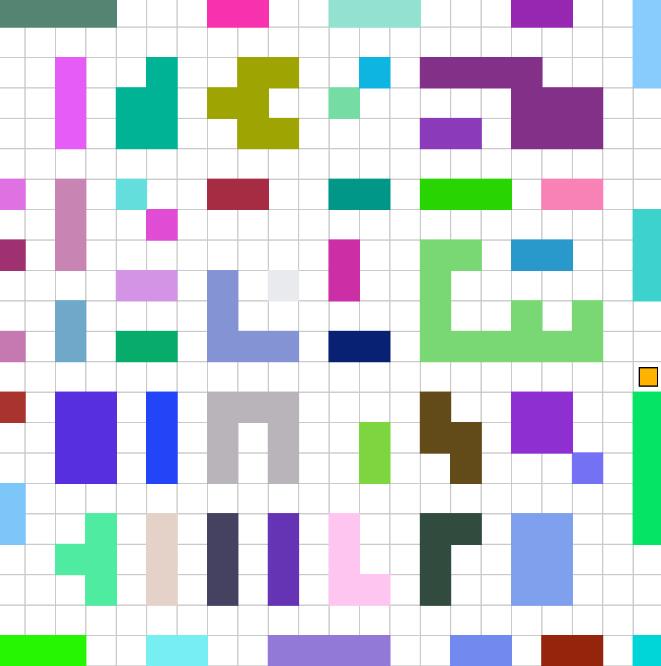
由于时间关系,不分析了,我自己贴代码吧。希望对一些也要用Tkinter的人有帮助。
from Tkinter import *
from random import *
import time
import numpy as np
import util

class Directions:
 NORTH = 'North'
 SOUTH = 'South'
 EAST = 'East'
 WEST = 'West'

# Detect elements in the map


window = Tk()
window.title('CityBusPlanner')
window.resizable(0,0)
width = 25
(x, y) = (22, 22)

totalsteps = 0

buidings = [(0, 0), (1, 0), (2, 0), (3, 0), (7, 0), (8, 0), (11, 0), (12, 0), (13, 0),
 (17, 0), (18, 0), (21, 0), (21, 1), (2, 2), (5, 2), (8, 2), (9, 2), (12, 2),
 (14, 2), (15, 2), (16, 2), (17, 2), (21, 2), (2, 3), (4, 3), (5, 3), (7, 3),
 (8, 3), (11, 3), (17, 3), (18, 3), (19, 3), (2, 4), (4, 4), (5, 4), (8, 4),
 (9, 4), (14, 4), (15, 4),(17, 4), (18, 4), (19, 4), (0, 6), (2, 6), (4, 6),
 (7, 6), (8, 6), (11, 6), (12, 6), (14, 6), (15, 6),(16, 6), (18, 6), (19, 6),
 (2, 7), (5, 7), (21, 7), (0, 8), (2, 8), (11, 8), (14, 8), (15, 8), (17, 8),
 (18, 8), (21, 8), (4, 9), (5, 9), (7, 9), (9, 9), (11, 9), (14, 9), (21, 9),
 (2, 10), (7, 10), (14, 10), (17, 10), (19, 10), (0, 11), (2, 11), (4, 11),
 (5, 11), (7, 11), (8, 11), (9, 11), (11, 11), (12, 11), (14, 11), (15, 11),
 (16, 11), (17, 11), (18, 11), (19, 11), (0, 13), (2, 13), (3, 13), (5, 13),
 (7, 13), (8, 13), (9, 13), (14, 13), (17, 13), (18, 13), (21, 13), (2, 14),
 (3, 14), (5, 14), (7, 14),(9, 14), (12, 14), (14, 14), (15, 14), (17, 14),
 (18, 14), (21, 14), (2, 15), (3, 15), (5, 15), (7, 15), (9, 15), (12, 15),
 (15, 15), (19, 15), (21, 15), (0, 16), (21, 16), (0, 17), (3, 17), (5, 17),
 (7, 17),(9, 17), (11, 17), (14, 17), (15, 17), (17, 17), (18, 17), (21, 17),
 (2, 18), (3, 18), (5, 18), (7, 18),(9, 18), (11, 18), (14, 18), (17, 18),
 (18, 18), (3, 19), (5, 19), (7, 19), (9, 19), (11, 19), (12, 19), (14, 19),
 (17, 19), (18, 19), (0, 21), (1, 21), (2, 21), (5, 21), (6, 21), (9, 21),
 (10, 21), (11, 21), (12, 21), (15, 21), (16, 21), (18, 21), (19, 21), (21, 21)]

walls = [(10, 0), (0, 12), (21, 12), (14, 21)]
park = [(14, 0), (15, 0), (16, 0)]
robotPos = (21, 12)

view = Canvas(window, width=x * width, height=y * width)
view.grid(row=0, column=0)
searchMapButton = Button(window,text = 'search')
searchMapButton.grid(row = 0,column = 1)
robotView = Canvas(window,width=x * width, height=y * width)
robotView.grid(row = 0,column = 2)

def formatColor(r, g, b):
 return '#%02x%02x%02x' % (int(r * 255), int(g * 255), int(b * 255))

def cityMap():
 global width, x, y, buidings,walls,park,robot
 for i in range(x):
 for j in range(y):
 view.create_rectangle(
 i * width, j * width, (i + 1) * width, (j + 1) * width, fill='white', outline='gray', width=1)
 for (i, j) in buidings:
 view.create_rectangle(
 i * width, j * width, (i + 1) * width, (j + 1) * width, fill='black', outline='gray', width=1)
 for (i,j) in walls:
 view.create_rectangle(
 i * width, j * width, (i + 1) * width, (j + 1) * width, fill='blue', outline='gray', width=1)
 for (i,j) in park:
 view.create_rectangle(
 i * width, j * width, (i + 1) * width, (j + 1) * width, fill='red', outline='gray', width=1)

def robotCityMap():
 global width, x, y, buidings,walls,park,robot,robotPos
 for i in range(x):
 for j in range(y):
 robotView.create_rectangle(
 i * width, j * width, (i + 1) * width, (j + 1) * width, fill='black', width=1)
 robotView.create_rectangle(
 robotPos[0] * width, robotPos[1] * width, (robotPos[0] + 1) * width, (robotPos[1] + 1) * width, fill='white', outline='gray', width=1)
# Create City Map
cityMap()

# Create Robot View
robotCityMap()
# Create a robot
robot = view.create_rectangle(robotPos[0] * width + width * 2 / 10, robotPos[1] * width + width * 2 / 10,
  robotPos[0] * width + width * 8 / 10, robotPos[1] * width + width * 8 / 10, fill="orange", width=1, tag="robot")
robotSelf = robotView.create_rectangle(robotPos[0] * width + width * 2 / 10, robotPos[1] * width + width * 2 / 10,
  robotPos[0] * width + width * 8 / 10, robotPos[1] * width + width * 8 / 10, fill="orange", width=1, tag="robot")

visited = [robotPos]

def move(dx,dy):
 global robot,x,y,robotPos,robotSelf,view
 global totalsteps
 totalsteps = totalsteps + 1
 newX = robotPos[0] + dx
 newY = robotPos[1] + dy
 if (not isEdge(newX, newY)) and (not isBlock(newX, newY)):
 #print "move %d" % totalsteps
 view.coords(robot, (newX) * width + width * 2 / 10, (newY) * width + width * 2 / 10,
  (newX) * width + width * 8 / 10, (newY) * width + width * 8 / 10)
 robotView.coords(robotSelf, (newX) * width + width * 2 / 10, (newY) * width + width * 2 / 10,
  (newX) * width + width * 8 / 10, (newY) * width + width * 8 / 10)
 robotPos = (newX, newY)
 if robotPos not in visited:
 visited.append(robotPos)
 visitedPanel = robotView.create_rectangle(
 robotPos[0] * width, robotPos[1] * width, (robotPos[0] + 1) * width, (robotPos[1] + 1) * width, fill='white', outline='gray', width=1)
 robotView.tag_lower(visitedPanel,robotSelf)
 else:
 print "move error"

def callUp(event):
 move(0,-1)

def callDown(event):
 move(0, 1)

def callLeft(event):
 move(-1, 0)

def callRight(event):
 move(1, 0)

def isBlock(newX,newY):
 global buidings,x,y


 for (i,j) in buidings:
 if (i == newX) and (j == newY):
 return True
 return False

def isEdge(newX,newY):
 global x,y

 if newX >= x or newY >= y or newX < 0 or newY < 0 :
 return True
 return False

def getSuccessors(robotPos):
 n = Directions.NORTH
 w = Directions.WEST
 s = Directions.SOUTH
 e = Directions.EAST
 successors = []
 posX = robotPos[0]
 posY = robotPos[1]

 if not isBlock(posX - 1, posY) and not isEdge(posX - 1,posY):
 successors.append(w)
 if not isBlock(posX, posY + 1) and not isEdge(posX,posY + 1):
 successors.append(s)
 if not isBlock(posX + 1, posY) and not isEdge(posX + 1,posY):
 successors.append(e)
 if not isBlock(posX, posY -1) and not isEdge(posX,posY - 1):
 successors.append(n)

 return successors

def getNewPostion(position,action):
 posX = position[0]
 posY = position[1]
 n = Directions.NORTH
 w = Directions.WEST
 s = Directions.SOUTH
 e = Directions.EAST
 if action == n:
 return (posX,posY - 1)
 elif action == w:
 return (posX - 1,posY)
 elif action == s:
 return (posX,posY + 1)
 elif action == e:
 return (posX + 1,posY)

delay = False
def runAction(actions):
 global delay
 n = Directions.NORTH
 w = Directions.WEST
 s = Directions.SOUTH
 e = Directions.EAST
 for i in actions:
 if delay:
 time.sleep(0.05)
 if i == n:
 #print "North"
 move(0, -1)
 elif i == w:
 #print "West"
 move(-1, 0)
 elif i == s:
 #print "South"
 move(0, 1)
 elif i == e:
 #sprint "East"
 move(1, 0)
 view.update()

def searchMapTest(event):
 global robotPos
 actions = []
 position = robotPos
 for i in range(100):
 successors = getSuccessors(position)
 successor = successors[randint(0, len(successors) - 1)]
 actions.append(successor)
 position = getNewPostion(position, successor)
 print actions
 runAction(actions)

def reverseSuccessor(successor):
 n = Directions.NORTH
 w = Directions.WEST
 s = Directions.SOUTH
 e = Directions.EAST
 if successor == n:
 return s
 elif successor == w:
 return e
 elif successor == s:
 return n
 elif successor == e:
 return w

roads = set()

detectedBuildings = {}
blockColors = {}
blockIndex = 0


def updateBuildings(detectedBuildings):
 global robotView,width
 for block,buildings in detectedBuildings.items():
 color = blockColors[block]
 for building in buildings:
 robotView.create_rectangle(
 building[0] * width, building[1] * width, (building[0] + 1) * width, (building[1] + 1) * width, fill=color, outline=color, width=1)

def addBuilding(position):
 global blockIndex,detectedBuildings
 isAdd = False
 addBlock = ''
 for block,buildings in detectedBuildings.items():
 for building in buildings:
 if building == position:
 return
 if util.manhattanDistance(position, building) == 1:
 if not isAdd:
  buildings.add(position)
  isAdd = True
  addBlock = block
  break
 else:
  #merge two block
  for building in detectedBuildings[block]:
  detectedBuildings[addBlock].add(building)
  detectedBuildings.pop(block)

 if not isAdd:
 newBlock = set([position])
 blockIndex = blockIndex + 1
 detectedBuildings['Block %d' % blockIndex] = newBlock
 color = formatColor(random(), random(), random())
 blockColors['Block %d' % blockIndex] = color
 updateBuildings(detectedBuildings)

def addRoad(position):
 global robotView,width,robotSelf
 visitedPanel = robotView.create_rectangle(
 position[0] * width, position[1] * width, (position[0] + 1) * width, (position[1] + 1) * width, fill='white', outline='gray', width=1)
 robotView.tag_lower(visitedPanel,robotSelf)

def showPath(positionA,positionB,path):
 global robotView,width,view
 view.create_oval(positionA[0] * width + width * 3 / 10, positionA[1] * width + width * 3 / 10,
  positionA[0] * width + width * 7 / 10, positionA[1] * width + width * 7 / 10, fill='yellow', width=1)
 nextPosition = positionA
 for action in path:
 nextPosition = getNewPostion(nextPosition, action)
 view.create_oval(nextPosition[0] * width + width * 4 / 10, nextPosition[1] * width + width * 4 / 10,
  nextPosition[0] * width + width * 6 / 10, nextPosition[1] * width + width * 6 / 10, fill='yellow', width=1)
 view.create_oval(positionB[0] * width + width * 3 / 10, positionB[1] * width + width * 3 / 10,
  positionB[0] * width + width * 7 / 10, positionB[1] * width + width * 7 / 10, fill='yellow', width=1)
hasDetected = set()


def detectLocation(position):
 if position not in hasDetected:
 hasDetected.add(position)
 if isBlock(position[0],position[1]):
 addBuilding(position)
 elif not isEdge(position[0],position[1]):
 addRoad(position)

def detect(position):
 posX = position[0]
 posY = position[1]

 detectLocation((posX,posY + 1))
 detectLocation((posX,posY - 1))
 detectLocation((posX + 1,posY))
 detectLocation((posX - 1,posY))


def heuristic(positionA,positionB):
 return util.manhattanDistance(positionA,positionB)

def AstarSearch(positionA,positionB):
 "Step 1: define closed: a set"
 closed = set()
 "Step 2: define fringe: a PriorityQueue "
 fringe = util.PriorityQueue()
 "Step 3: insert initial node to fringe"
 "Construct node to be a tuple (location,actions)"
 initialNode = (positionA,[])
 initCost = 0 + heuristic(initialNode[0],positionB)
 fringe.push(initialNode,initCost)
 "Step 4: Loop to do search"
 while not fringe.isEmpty():
 node = fringe.pop()
 if node[0] == positionB:
 return node[1]
 if node[0] not in closed:
 closed.add(node[0])
 for successor in getSuccessors(node[0]):
 actions = list(node[1])
 actions.append(successor)
 newPosition = getNewPostion(node[0], successor)
 childNode = (newPosition,actions)
 cost = len(actions) + heuristic(childNode[0],positionB)
 fringe.push(childNode,cost)
 return []

def AstarSearchBetweenbuildings(building1,building2):
 "Step 1: define closed: a set"
 closed = set()
 "Step 2: define fringe: a PriorityQueue "
 fringe = util.PriorityQueue()
 "Step 3: insert initial node to fringe"
 "Construct node to be a tuple (location,actions)"
 initialNode = (building1,[])
 initCost = 0 + heuristic(initialNode[0],building2)
 fringe.push(initialNode,initCost)
 "Step 4: Loop to do search"
 while not fringe.isEmpty():
 node = fringe.pop()
 if util.manhattanDistance(node[0],building2) == 1:
 return node[1]
 if node[0] not in closed:
 closed.add(node[0])
 for successor in getSuccessors(node[0]):
 actions = list(node[1])
 actions.append(successor)
 newPosition = getNewPostion(node[0], successor)
 childNode = (newPosition,actions)
 cost = len(actions) + heuristic(childNode[0],building2)
 fringe.push(childNode,cost)
 return []

def calculatePositions(buildingA,path):
 positions = set()
 positions.add(buildingA)
 nextPosition = buildingA
 for action in path:
 nextPosition = getNewPostion(nextPosition, action)
 positions.add(nextPosition)
 return positions

def showRoad(fullRoad):
 global view,width
 for road in fullRoad:
 view.create_oval(road[0] * width + width * 4 / 10, road[1] * width + width * 4 / 10,
  road[0] * width + width * 6 / 10, road[1] * width + width * 6 / 10, fill='yellow', width=1)
 view.update()


def search(node):
 successors = getSuccessors(node[0])
 detect(node[0])
 for successor in successors:
 nextPosition = getNewPostion(node[0], successor)
 if nextPosition not in roads:
 runAction([successor]) # to the next node
 roads.add(nextPosition)
 search((nextPosition,[successor],[reverseSuccessor(successor)]))
 runAction(node[2]) #back to top node

def searchConsiderTopVisit(node,topWillVisit):
 successors = getSuccessors(node[0])
 detect(node[0])
 newTopWillVisit = set(topWillVisit)
 for successor in successors:
 nextPosition = getNewPostion(node[0], successor)
 newTopWillVisit.add(nextPosition)
 for successor in successors:
 nextPosition = getNewPostion(node[0], successor)
 if nextPosition not in roads and nextPosition not in topWillVisit:
 runAction([successor]) # to the next node
 roads.add(nextPosition)
 newTopWillVisit.remove(nextPosition)
 searchConsiderTopVisit((nextPosition,[successor],[reverseSuccessor(successor)]),newTopWillVisit)
 runAction(node[2]) #back to top node


def searchShortestPathBetweenBlocks(block1,block2):
 shortestPath = []
 buildingA = (0,0)
 buildingB = (0,0)
 for building1 in block1:
 for building2 in block2:
 path = AstarSearchBetweenbuildings(building1, building2)
 if len(shortestPath) == 0:
 shortestPath = path
 buildingA = building1
 buildingB = building2
 elif len(path) < len(shortestPath):
 shortestPath = path
 buildingA = building1
 buildingB = building2
 return (buildingA,buildingB,shortestPath)

def addBuildingToBlocks(linkedBlock,buildingA):
 global detectedBuildings
 newLinkedBlock = linkedBlock.copy()
 for block,buildings in detectedBuildings.items():
 for building in buildings:
 if util.manhattanDistance(buildingA, building) == 1:
  newLinkedBlock[block] = buildings
  break
 return newLinkedBlock

def bfsSearchNextBlock(initBuilding,linkedBlock):
 global detectedBuildings
 closed = set()
 fringe = util.Queue()
 initNode = (initBuilding,[])
 fringe.push(initNode)
 while not fringe.isEmpty():
 node = fringe.pop()
 newLinkedBlock = addBuildingToBlocks(linkedBlock,node[0])
 if len(newLinkedBlock) == len(detectedBuildings):
 return node[1]
 if len(newLinkedBlock) > len(linkedBlock): # find a new block
 actions = list(node[1])
 '''
 if len(node[1]) > 0:
 lastAction = node[1][len(node[1]) - 1]
 for successor in getSuccessors(node[0]):
  if successor == lastAction:
  nextPosition = getNewPostion(node[0], successor)
  actions.append(successor)
  return actions + bfsSearchNextBlock(nextPosition, newLinkedBlock)
 '''
 return node[1] + bfsSearchNextBlock(node[0], newLinkedBlock)

 if node[0] not in closed:
 closed.add(node[0])
 for successor in getSuccessors(node[0]):
 actions = list(node[1])
 actions.append(successor)
 nextPosition = getNewPostion(node[0], successor)

 childNode = (nextPosition,actions)
 fringe.push(childNode)
 return []

def isGoal(node):
 global detectedBuildings,robotPos
 linkedBlock = {}
 positions = calculatePositions(robotPos, node[1])
 for position in positions:
 for block,buildings in detectedBuildings.items():
 for building in buildings:
  if util.manhattanDistance(position, building) == 1:
  linkedBlock[block] = buildings
 print len(linkedBlock)
 if len(linkedBlock) == 17:
 return True
 else:
 return False

def roadHeuristic(road):
 return 0

def AstarSearchRoad():
 global robotPos,detectedBuildings
 "Step 1: define closed: a set"
 closed = set()
 "Step 2: define fringe: a PriorityQueue "
 fringe = util.PriorityQueue()
 "Step 3: insert initial node to fringe"
 "Construct node to be a tuple (location,actions)"
 initRoad = (robotPos,[])
 initCost = 0 + roadHeuristic(initRoad)
 fringe.push(initRoad,initCost)
 "Step 4: Loop to do search"
 while not fringe.isEmpty():
 node = fringe.pop()
 if isGoal(node):
 print len(closed)
 return node[1]
 if node[0] not in closed:
 closed.add(node[0])
 for successor in getSuccessors(node[0]):
 actions = list(node[1])
 actions.append(successor)
 newPosition = getNewPostion(node[0], successor)
 childNode = (newPosition,actions)
 cost = len(actions) + roadHeuristic(childNode)
 fringe.push(childNode,cost)

 return []

def searchRoad(building):
 global detectedBuildings,robotPos
 linkedBlock = {}
 initBuilding = building

 return bfsSearchNextBlock(initBuilding,linkedBlock)

def searchShortestRoad():
 shortestRoad = []
 shortestPositions = set()
 for block,buildings in detectedBuildings.items():
 for building in buildings:
 road = searchRoad(building)
 positions = calculatePositions(building, road)
 if len(shortestPositions) == 0 or len(positions) < len(shortestPositions):
 shortestRoad = road
 shortestPositions = positions
 print len(shortestPositions)
 showRoad(shortestPositions)

def searchMap(event):
 print "Search Map"
 global robotPos,roads,detectedBuildings,delay
 actions = []
 #roads = set()s
 #roads.add(robotPos)
 #fringe = util.Stack()
 initNode = (robotPos,[],[]) # (position,forwardActions,backwarsdActions)
 #fringe.push(initNode)
 roads.add(robotPos)
 search(initNode)
 #searchConsiderTopVisit(initNode, set())
 print detectedBuildings
 print len(detectedBuildings)
 #path = AstarSearchBetweenbuildings((6,21), (2, 18))
 #showPath((6,21),(2,18), path)
 '''
 shortestRoad = set()
 for block1 in detectedBuildings.values():
 roads = set()
 for block2 in detectedBuildings.values():
 if not block1 == block2:
 (buildingA,buildingB,path) = searchShortestPathBetweenBlocks(block1, block2)
 #showPath(buildingA,buildingB,path)
 positions = calculatePositions(buildingA,buildingB,path)
 roads = roads | positions
 if len(shortestRoad) == 0 or len(roads) < len(shortestRoad):
 shortestRoad = roads
 print len(shortestRoad)
 showRoad(shortestRoad)
 '''
 '''
 block1 = detectedBuildings.values()[3]
 print block1
 block2 = detectedBuildings.values()[5]
 print block2
 (buildingA,buildingB,path) = searchShortestPathBetweenBlocks(block1, block2)
 print buildingA,buildingB,path
 showPath(buildingA,buildingB,path)

 block1 = detectedBuildings.values()[10]
 print block1
 block2 = detectedBuildings.values()[20]
 print block2
 (buildingA,buildingB,path) = searchShortestPathBetweenBlocks(block1, block2)
 print buildingA,buildingB,path
 showPath(buildingA,buildingB,path)
 '''
 searchShortestRoad()

 '''
 path = searchRoad()
 #path = AstarSearchRoad()
 positions = calculatePositions(robotPos, path)
 print len(positions)
 showRoad(positions)
 delay = True
 #runAction(path)
 '''


window.bind("<Up>", callUp)
window.bind("<Down>", callDown)
window.bind("<Right>", callRight)
window.bind("<Left>", callLeft)
window.bind("s", searchMap)
searchMapButton.bind("<Button-1>",searchMap)
window.mainloop()
下面的util.py使用的是加州伯克利的代码:
# util.py
# -------
# Licensing Information: You are free to use or extend these projects for
# educational purposes provided that (1) you do not distribute or publish
# solutions, (2) you retain this notice, and (3) you provide clear
# attribution to UC Berkeley, including a link to http://ai.berkeley.edu.
#
# Attribution Information: The Pacman AI projects were developed at UC Berkeley.
# The core projects and autograders were primarily created by John DeNero
# (denero@cs.berkeley.edu) and Dan Klein (klein@cs.berkeley.edu).
# Student side autograding was added by Brad Miller, Nick Hay, and
# Pieter Abbeel (pabbeel@cs.berkeley.edu).


import sys
import inspect
import heapq, random


"""
 Data structures useful for implementing SearchAgents
"""

class Stack:
 "A container with a last-in-first-out (LIFO) queuing policy."
 def __init__(self):
 self.list = []

 def push(self,item):
 "Push 'item' onto the stack"
 self.list.append(item)

 def pop(self):
 "Pop the most recently pushed item from the stack"
 return self.list.pop()

 def isEmpty(self):
 "Returns true if the stack is empty"
 return len(self.list) == 0

class Queue:
 "A container with a first-in-first-out (FIFO) queuing policy."
 def __init__(self):
 self.list = []

 def push(self,item):
 "Enqueue the 'item' into the queue"
 self.list.insert(0,item)

 def pop(self):
 """
 Dequeue the earliest enqueued item still in the queue. This
 operation removes the item from the queue.
 """
 return self.list.pop()

 def isEmpty(self):
 "Returns true if the queue is empty"
 return len(self.list) == 0

class PriorityQueue:
 """
 Implements a priority queue data structure. Each inserted item
 has a priority associated with it and the client is usually interested
 in quick retrieval of the lowest-priority item in the queue. This
 data structure allows O(1) access to the lowest-priority item.

 Note that this PriorityQueue does not allow you to change the priority
 of an item. However, you may insert the same item multiple times with
 different priorities.
 """
 def __init__(self):
 self.heap = []
 self.count = 0

 def push(self, item, priority):
 # FIXME: restored old behaviour to check against old results better
 # FIXED: restored to stable behaviour
 entry = (priority, self.count, item)
 # entry = (priority, item)
 heapq.heappush(self.heap, entry)
 self.count += 1

 def pop(self):
 (_, _, item) = heapq.heappop(self.heap)
 # (_, item) = heapq.heappop(self.heap)
 return item

 def isEmpty(self):
 return len(self.heap) == 0

class PriorityQueueWithFunction(PriorityQueue):
 """
 Implements a priority queue with the same push/pop signature of the
 Queue and the Stack classes. This is designed for drop-in replacement for
 those two classes. The caller has to provide a priority function, which
 extracts each item's priority.
 """
 def __init__(self, priorityFunction):
 "priorityFunction (item) -> priority"
 self.priorityFunction = priorityFunction # store the priority function
 PriorityQueue.__init__(self) # super-class initializer

 def push(self, item):
 "Adds an item to the queue with priority from the priority function"
 PriorityQueue.push(self, item, self.priorityFunction(item))


def manhattanDistance( xy1, xy2 ):
 "Returns the Manhattan distance between points xy1 and xy2"
 return abs( xy1[0] - xy2[0] ) + abs( xy1[1] - xy2[1] )
以上就是本文的全部内容,希望对大家的学习有所帮助,也希望大家多多支持【听图阁-专注于Python设计】。