tensorflow识别自己手写数字
tensorflow作为google开源的项目,现在赶超了caffe,好像成为最受欢迎的深度学习框架。确实在编写的时候更能感受到代码的真实存在,这点和caffe不同,caffe通过编写配置文件进行网络的生成。环境tensorflow是0.10的版本,注意其他版本有的语句会有错误,这是tensorflow版本之间的兼容问题。
还需要安装PIL:pip install Pillow
图片的格式:
– 图像标准化,可安装在20×20像素的框内,同时保留其长宽比。
– 图片都集中在一个28×28的图像中。
– 像素以列为主进行排序。像素值0到255,0表示背景(白色),255表示前景(黑色)。
创建一个.png的文件,背景是白色的,手写的字体是黑色的,
下面是数据测试的代码,一个两层的卷积神经网,然后用save进行模型的保存。
# coding: UTF-8
import tensorflow as tf
import numpy as np
import matplotlib.pyplot as plt
import input_data
'''''
得到数据
'''
mnist = input_data.read_data_sets("MNIST_data/", one_hot=True)

training = mnist.train.images
trainlable = mnist.train.labels
testing = mnist.test.images
testlabel = mnist.test.labels

print ("MNIST loaded")
# 获取交互式的方式
sess = tf.InteractiveSession()
# 初始化变量
x = tf.placeholder("float", shape=[None, 784])
y_ = tf.placeholder("float", shape=[None, 10])
W = tf.Variable(tf.zeros([784, 10]))
b = tf.Variable(tf.zeros([10]))
'''''
生成权重函数,其中shape是数据的形状
'''
def weight_variable(shape):
  initial = tf.truncated_normal(shape, stddev=0.1)
  return tf.Variable(initial)
'''''
生成偏执项 其中shape是数据形状
'''
def bias_variable(shape):
  initial = tf.constant(0.1, shape=shape)
  return tf.Variable(initial)

def conv2d(x, W):
  return tf.nn.conv2d(x, W, strides=[1, 1, 1, 1], padding='SAME')

def max_pool_2x2(x):
  return tf.nn.max_pool(x, ksize=[1, 2, 2, 1],
             strides=[1, 2, 2, 1], padding='SAME')

W_conv1 = weight_variable([5, 5, 1, 32])
b_conv1 = bias_variable([32])
x_image = tf.reshape(x, [-1, 28, 28, 1])

h_conv1 = tf.nn.relu(conv2d(x_image, W_conv1) + b_conv1)
h_pool1 = max_pool_2x2(h_conv1)

W_conv2 = weight_variable([5, 5, 32, 64])
b_conv2 = bias_variable([64])

h_conv2 = tf.nn.relu(conv2d(h_pool1, W_conv2) + b_conv2)
h_pool2 = max_pool_2x2(h_conv2)


W_fc1 = weight_variable([7 * 7 * 64, 1024])
b_fc1 = bias_variable([1024])

h_pool2_flat = tf.reshape(h_pool2, [-1, 7*7*64])
h_fc1 = tf.nn.relu(tf.matmul(h_pool2_flat, W_fc1) + b_fc1)

keep_prob = tf.placeholder("float")
h_fc1_drop = tf.nn.dropout(h_fc1, keep_prob)

W_fc2 = weight_variable([1024, 10])
b_fc2 = bias_variable([10])

y_conv=tf.nn.softmax(tf.matmul(h_fc1_drop, W_fc2) + b_fc2)

cross_entropy = -tf.reduce_sum(y_*tf.log(y_conv))
train_step = tf.train.AdamOptimizer(1e-4).minimize(cross_entropy)
correct_prediction = tf.equal(tf.argmax(y_conv, 1), tf.argmax(y_, 1))
accuracy = tf.reduce_mean(tf.cast(correct_prediction, "float"))

# 保存网络训练的参数
saver = tf.train.Saver()
sess.run(tf.initialize_all_variables())
for i in range(8000):
 batch = mnist.train.next_batch(50)
 if i%100 == 0:
  train_accuracy = accuracy.eval(feed_dict={
    x:batch[0], y_: batch[1], keep_prob: 1.0})
  print "step %d, training accuracy %g"%(i, train_accuracy)
 train_step.run(feed_dict={x: batch[0], y_: batch[1], keep_prob: 0.5})

save_path = saver.save(sess, "model_mnist.ckpt")
print("Model saved in life:", save_path)

print "test accuracy %g"%accuracy.eval(feed_dict={
  x: mnist.test.images, y_: mnist.test.labels, keep_prob: 1.0})
其中input_data.py如下代码,是进行mnist数据集的下载的:代码是由mnist数据集提供的官方下载的版本。
# Copyright 2015 Google Inc. All Rights Reserved.
#
# Licensed under the Apache License, Version 2.0 (the "License");
# you may not use this file except in compliance with the License.
# You may obtain a copy of the License at
#
#   http://www.apache.org/licenses/LICENSE-2.0
#
# Unless required by applicable law or agreed to in writing, software
# distributed under the License is distributed on an "AS IS" BASIS,
# WITHOUT WARRANTIES OR CONDITIONS OF ANY KIND, either express or implied.
# See the License for the specific language governing permissions and
# limitations under the License.
# ==============================================================================
"""Functions for downloading and reading MNIST data."""
from __future__ import absolute_import
from __future__ import division
from __future__ import print_function
import gzip
import os
import tensorflow.python.platform
import numpy
from six.moves import urllib
from six.moves import xrange # pylint: disable=redefined-builtin
import tensorflow as tf
SOURCE_URL = 'http://yann.lecun.com/exdb/mnist/'
def maybe_download(filename, work_directory):
 """Download the data from Yann's website, unless it's already here."""
 if not os.path.exists(work_directory):
  os.mkdir(work_directory)
 filepath = os.path.join(work_directory, filename)
 if not os.path.exists(filepath):
  filepath, _ = urllib.request.urlretrieve(SOURCE_URL + filename, filepath)
  statinfo = os.stat(filepath)
  print('Successfully downloaded', filename, statinfo.st_size, 'bytes.')
 return filepath
def _read32(bytestream):
 dt = numpy.dtype(numpy.uint32).newbyteorder('>')
 return numpy.frombuffer(bytestream.read(4), dtype=dt)[0]
def extract_images(filename):
 """Extract the images into a 4D uint8 numpy array [index, y, x, depth]."""
 print('Extracting', filename)
 with gzip.open(filename) as bytestream:
  magic = _read32(bytestream)
  if magic != 2051:
   raise ValueError(
     'Invalid magic number %d in MNIST image file: %s' %
     (magic, filename))
  num_images = _read32(bytestream)
  rows = _read32(bytestream)
  cols = _read32(bytestream)
  buf = bytestream.read(rows * cols * num_images)
  data = numpy.frombuffer(buf, dtype=numpy.uint8)
  data = data.reshape(num_images, rows, cols, 1)
  return data
def dense_to_one_hot(labels_dense, num_classes=10):
 """Convert class labels from scalars to one-hot vectors."""
 num_labels = labels_dense.shape[0]
 index_offset = numpy.arange(num_labels) * num_classes
 labels_one_hot = numpy.zeros((num_labels, num_classes))
 labels_one_hot.flat[index_offset + labels_dense.ravel()] = 1
 return labels_one_hot
def extract_labels(filename, one_hot=False):
 """Extract the labels into a 1D uint8 numpy array [index]."""
 print('Extracting', filename)
 with gzip.open(filename) as bytestream:
  magic = _read32(bytestream)
  if magic != 2049:
   raise ValueError(
     'Invalid magic number %d in MNIST label file: %s' %
     (magic, filename))
  num_items = _read32(bytestream)
  buf = bytestream.read(num_items)
  labels = numpy.frombuffer(buf, dtype=numpy.uint8)
  if one_hot:
   return dense_to_one_hot(labels)
  return labels
class DataSet(object):
 def __init__(self, images, labels, fake_data=False, one_hot=False,
        dtype=tf.float32):
  """Construct a DataSet.
  one_hot arg is used only if fake_data is true. `dtype` can be either
  `uint8` to leave the input as `[0, 255]`, or `float32` to rescale into
  `[0, 1]`.
  """
  dtype = tf.as_dtype(dtype).base_dtype
  if dtype not in (tf.uint8, tf.float32):
   raise TypeError('Invalid image dtype %r, expected uint8 or float32' %
           dtype)
  if fake_data:
   self._num_examples = 10000
   self.one_hot = one_hot
  else:
   assert images.shape[0] == labels.shape[0], (
     'images.shape: %s labels.shape: %s' % (images.shape,
                         labels.shape))
   self._num_examples = images.shape[0]
   # Convert shape from [num examples, rows, columns, depth]
   # to [num examples, rows*columns] (assuming depth == 1)
   assert images.shape[3] == 1
   images = images.reshape(images.shape[0],
               images.shape[1] * images.shape[2])
   if dtype == tf.float32:
    # Convert from [0, 255] -> [0.0, 1.0].
    images = images.astype(numpy.float32)
    images = numpy.multiply(images, 1.0 / 255.0)
  self._images = images
  self._labels = labels
  self._epochs_completed = 0
  self._index_in_epoch = 0
 @property
 def images(self):
  return self._images
 @property
 def labels(self):
  return self._labels
 @property
 def num_examples(self):
  return self._num_examples
 @property
 def epochs_completed(self):
  return self._epochs_completed
 def next_batch(self, batch_size, fake_data=False):
  """Return the next `batch_size` examples from this data set."""
  if fake_data:
   fake_image = [1] * 784
   if self.one_hot:
    fake_label = [1] + [0] * 9
   else:
    fake_label = 0
   return [fake_image for _ in xrange(batch_size)], [
     fake_label for _ in xrange(batch_size)]
  start = self._index_in_epoch
  self._index_in_epoch += batch_size
  if self._index_in_epoch > self._num_examples:
   # Finished epoch
   self._epochs_completed += 1
   # Shuffle the data
   perm = numpy.arange(self._num_examples)
   numpy.random.shuffle(perm)
   self._images = self._images[perm]
   self._labels = self._labels[perm]
   # Start next epoch
   start = 0
   self._index_in_epoch = batch_size
   assert batch_size <= self._num_examples
  end = self._index_in_epoch
  return self._images[start:end], self._labels[start:end]
def read_data_sets(train_dir, fake_data=False, one_hot=False, dtype=tf.float32):
 class DataSets(object):
  pass
 data_sets = DataSets()
 if fake_data:
  def fake():
   return DataSet([], [], fake_data=True, one_hot=one_hot, dtype=dtype)
  data_sets.train = fake()
  data_sets.validation = fake()
  data_sets.test = fake()
  return data_sets
 TRAIN_IMAGES = 'train-images-idx3-ubyte.gz'
 TRAIN_LABELS = 'train-labels-idx1-ubyte.gz'
 TEST_IMAGES = 't10k-images-idx3-ubyte.gz'
 TEST_LABELS = 't10k-labels-idx1-ubyte.gz'
 VALIDATION_SIZE = 5000
 local_file = maybe_download(TRAIN_IMAGES, train_dir)
 train_images = extract_images(local_file)
 local_file = maybe_download(TRAIN_LABELS, train_dir)
 train_labels = extract_labels(local_file, one_hot=one_hot)
 local_file = maybe_download(TEST_IMAGES, train_dir)
 test_images = extract_images(local_file)
 local_file = maybe_download(TEST_LABELS, train_dir)
 test_labels = extract_labels(local_file, one_hot=one_hot)
 validation_images = train_images[:VALIDATION_SIZE]
 validation_labels = train_labels[:VALIDATION_SIZE]
 train_images = train_images[VALIDATION_SIZE:]
 train_labels = train_labels[VALIDATION_SIZE:]
 data_sets.train = DataSet(train_images, train_labels, dtype=dtype)
 data_sets.validation = DataSet(validation_images, validation_labels,
                 dtype=dtype)
 data_sets.test = DataSet(test_images, test_labels, dtype=dtype)
 return data_sets
然后进行代码的测试:
# import modules
import sys
import tensorflow as tf
from PIL import Image, ImageFilter


def predictint(imvalue):
  """
  This function returns the predicted integer.
  The imput is the pixel values from the imageprepare() function.
  """

  # Define the model (same as when creating the model file)
  x = tf.placeholder(tf.float32, [None, 784])
  W = tf.Variable(tf.zeros([784, 10]))
  b = tf.Variable(tf.zeros([10]))

  def weight_variable(shape):
    initial = tf.truncated_normal(shape, stddev=0.1)
    return tf.Variable(initial)

  def bias_variable(shape):
    initial = tf.constant(0.1, shape=shape)
    return tf.Variable(initial)

  def conv2d(x, W):
    return tf.nn.conv2d(x, W, strides=[1, 1, 1, 1], padding='SAME')

  def max_pool_2x2(x):
    return tf.nn.max_pool(x, ksize=[1, 2, 2, 1], strides=[1, 2, 2, 1], padding='SAME')

  W_conv1 = weight_variable([5, 5, 1, 32])
  b_conv1 = bias_variable([32])

  x_image = tf.reshape(x, [-1, 28, 28, 1])
  h_conv1 = tf.nn.relu(conv2d(x_image, W_conv1) + b_conv1)
  h_pool1 = max_pool_2x2(h_conv1)

  W_conv2 = weight_variable([5, 5, 32, 64])
  b_conv2 = bias_variable([64])

  h_conv2 = tf.nn.relu(conv2d(h_pool1, W_conv2) + b_conv2)
  h_pool2 = max_pool_2x2(h_conv2)

  W_fc1 = weight_variable([7 * 7 * 64, 1024])
  b_fc1 = bias_variable([1024])

  h_pool2_flat = tf.reshape(h_pool2, [-1, 7 * 7 * 64])
  h_fc1 = tf.nn.relu(tf.matmul(h_pool2_flat, W_fc1) + b_fc1)

  keep_prob = tf.placeholder(tf.float32)
  h_fc1_drop = tf.nn.dropout(h_fc1, keep_prob)

  W_fc2 = weight_variable([1024, 10])
  b_fc2 = bias_variable([10])

  y_conv = tf.nn.softmax(tf.matmul(h_fc1_drop, W_fc2) + b_fc2)

  init_op = tf.initialize_all_variables()
  saver = tf.train.Saver()

  """
  Load the model_mnist.ckpt file
  file is stored in the same directory as this python script is started
  Use the model to predict the integer. Integer is returend as list.
  Based on the documentatoin at
  https://www.tensorflow.org/versions/master/how_tos/variables/index.html
  """
  with tf.Session() as sess:
    sess.run(init_op)
    saver.restore(sess, "model_mnist.ckpt")
    # print ("Model restored.")

    prediction = tf.argmax(y_conv, 1)
    return prediction.eval(feed_dict={x: [imvalue], keep_prob: 1.0}, session=sess)


def imageprepare(argv):
  """
  This function returns the pixel values.
  The imput is a png file location.
  """
  im = Image.open(argv).convert('L')
  width = float(im.size[0])
  height = float(im.size[1])
  newImage = Image.new('L', (28, 28), (255)) # creates white canvas of 28x28 pixels

  if width > height: # check which dimension is bigger
    # Width is bigger. Width becomes 20 pixels.
    nheight = int(round((20.0 / width * height), 0)) # resize height according to ratio width
    if (nheight == 0): # rare case but minimum is 1 pixel
      nheigth = 1
      # resize and sharpen
    img = im.resize((20, nheight), Image.ANTIALIAS).filter(ImageFilter.SHARPEN)
    wtop = int(round(((28 - nheight) / 2), 0)) # caculate horizontal pozition
    newImage.paste(img, (4, wtop)) # paste resized image on white canvas
  else:
    # Height is bigger. Heigth becomes 20 pixels.
    nwidth = int(round((20.0 / height * width), 0)) # resize width according to ratio height
    if (nwidth == 0): # rare case but minimum is 1 pixel
      nwidth = 1
      # resize and sharpen
    img = im.resize((nwidth, 20), Image.ANTIALIAS).filter(ImageFilter.SHARPEN)
    wleft = int(round(((28 - nwidth) / 2), 0)) # caculate vertical pozition
    newImage.paste(img, (wleft, 4)) # paste resized image on white canvas

  # newImage.save("sample.png")

  tv = list(newImage.getdata()) # get pixel values

  # normalize pixels to 0 and 1. 0 is pure white, 1 is pure black.
  tva = [(255 - x) * 1.0 / 255.0 for x in tv]
  return tva
  # print(tva)


def main(argv):
  """
  Main function.
  """
  imvalue = imageprepare(argv)
  predint = predictint(imvalue)
  print (predint[0]) # first value in list


if __name__ == "__main__":
  main('2.png')
其中我用于测试的代码如下:
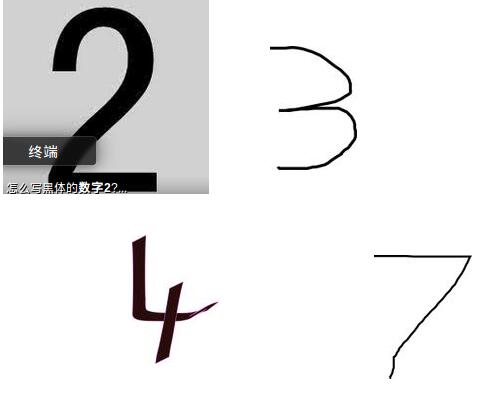
可以将图片另存到路径下面,然后进行测试。
(1)载入我的手写数字的图像。
(2)将图像转换为黑白(模式“L”)
(3)确定原始图像的尺寸是最大的
(4)调整图像的大小,使得最大尺寸(醚的高度及宽度)为20像素,并且以相同的比例最小化尺寸刻度。
(5)锐化图像。这会极大地强化结果。
(6)把图像粘贴在28×28像素的白色画布上。在最大的尺寸上从顶部或侧面居中图像4个像素。最大尺寸始终是20个像素和4 + 20 + 4 = 28,最小尺寸被定位在28和缩放的图像的新的大小之间差的一半。
(7)获取新的图像(画布+居中的图像)的像素值。
(8)归一化像素值到0和1之间的一个值(这也在TensorFlow MNIST教程中完成)。其中0是白色的,1是纯黑色。从步骤7得到的像素值是与之相反的,其中255是白色的,0黑色,所以数值必须反转。下述公式包括反转和规格化(255-X)* 1.0 / 255.0