python实现两个文件合并功能
本文将会分析一个文件合并的程序,并指出在合并文件过程中需要注意的问题。
下面是需要合并的文件示例:
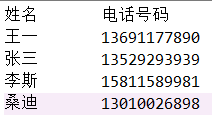

分析思路:
要将两个文件合并,首先要将文件读到内存中,成为列表。再将列表分割,按照类别将数据分开存储,即姓名、电话、邮箱。通过遍历列表1,依次与列表2比较,如果二者有重合的人,那么直接利用 .join([ ])姓名电话邮箱合并到一行,保存到另外一个列表变量里面。二者不重合的人,说明只有列表1中才有,故将此人的邮箱信息用str(‘—–')代替。
经过这次遍历之后,列表1中所有的人和列表2中与列表1中重复的人,都重新整合到了新的列表变量里面。接下来还需要把列表2中特有的人,添加到新的列表变量中。方法是遍历列表2,把与列表1不重合的人取出来保存。
最后要将新的列表变量中的数据写入到新的文件中,并关闭所有文件。
流程图如下:

代码如下:
"""
Created on Fri Aug 4 12:59:36 2017

@author: 13323
"""
# This program can combine two or more files into one file.
def main():
 #firstly open the files
 data1 = open("test_3.txt","rb")
 data2 = open("test_4.txt","rb")

 # read the data in file into list
 data1.readline() #only read one line, skip the first line
 data2.readline() #only read one line, skip the first line
 file1 = data1.readlines() #read all variable into list file1
 file2 = data2.readlines() #read all variable into list file2
 #print(file1)

 #define particular list to store variable
 file1_name = []
 file1_tel = []
 file2_name = []
 file2_email = []
 #file3 = []

 #split file1 into two part
 for line in file1:
  element = line.split() #line.split(); devide by ' '
  file1_name.append(str(element[0].decode('gbk')))
  file1_tel.append(str(element[1].decode('gbk')))

 #split file2 into two part
 for line in file2:
  element = line.split()
  file2_name.append(str(element[0].decode('gbk')))
  file2_email.append(str(element[1].decode('gbk')))

 # pick up the name in the file1 same as the name in the file2 and combine
 file3 = []
 for i in range(len(file1_name)):
  s = ''
  if file1_name[i] in file2_name:
   j = file2_name.index(file1_name[i])
   s = '\t'.join([file1_name[i],file1_tel[i],file2_email[j]])
   s += '\n'
  else:
   s = '\t'.join([file1_name[i],file1_tel[i],str("----")])
   s += '\n'
  file3.append(s)

 #pick up the name in the file1 doesn't same as the name in the file2
 for i in range(len(file2_name)):
  s = ''
  if file2_name[i] not in file1_name:
   s = '\t'.join([file2_name[i],str('----'),file2_email[i]])
   s += '\n'
  file3.append(s)

 #write the data into file3
 data3 = open("test_5.txt","w")
 data3.writelines(file3)

 #close the file
 data1.close()
 data2.close()
 data3.close()

main()
关键点:
编码与解码
列表合并与拆解
以上就是本文的全部内容,希望对大家的学习有所帮助,也希望大家多多支持【听图阁-专注于Python设计】。