pyqt远程批量执行Linux命令程序的方法
写了个小程序:
功能
1.测试远程ssh连接是否成功,
2.批量执行远程ssh命令
效果如下:
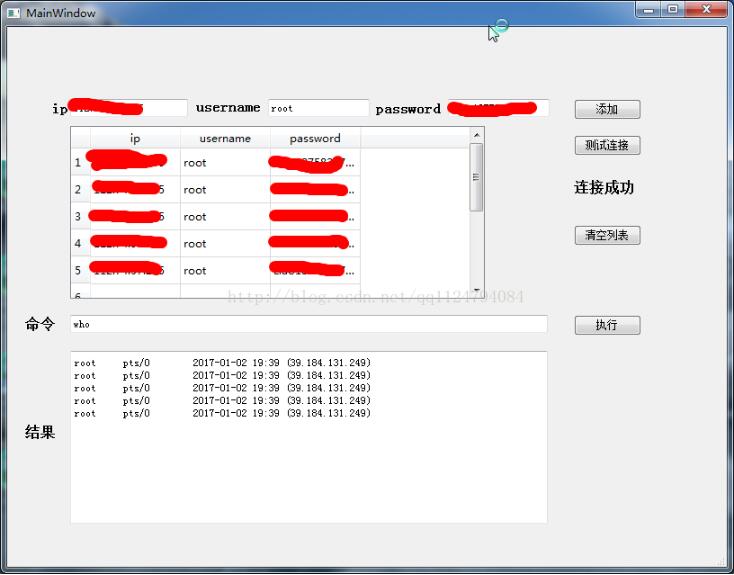
代码如下:
#-*- coding:utf-8 -*-
import sys
from PyQt4 import QtCore, QtGui, uic
import locale
import re
import os
from PyQt4.QtCore import *
from PyQt4.QtGui import *
import paramiko
qtCreatorFile = "test.ui" # Enter file here.

Ui_MainWindow, QtBaseClass = uic.loadUiType(qtCreatorFile)
a = 0
username_list = []
ip_list = []
password_list = []
class MyApp(QtGui.QMainWindow, Ui_MainWindow):
  def __init__(self):
    QtGui.QMainWindow.__init__(self)
    Ui_MainWindow.__init__(self)
    self.setupUi(self)
    self.add.clicked.connect(self.add_info)
    self.test.clicked.connect(self.test_link)
    self.do_2.clicked.connect(self.do_command)
  def add_info(self):
    global a
    ip = self.ip.text()
    ip_list.append(ip)
    username = self.username.text()
    username_list.append(username)
    password = self.password.text()
    password_list.append(password)
    self.table.setHorizontalHeaderLabels(['ip','username','password'])
    newItem = QTableWidgetItem(ip)
    self.table.setItem(a, 0, newItem)

    newItem = QTableWidgetItem(username)
    self.table.setItem(a, 1, newItem)

    newItem = QTableWidgetItem(password)
    self.table.setItem(a, 2, newItem)
    a += 1
  def test_link(self):
    ip = str(self.ip.text())
    username = str(self.username.text())
    password = str(self.password.text())
    try:
      ssh = paramiko.SSHClient()
      ssh.set_missing_host_key_policy(paramiko.AutoAddPolicy())
      ssh.connect(ip, 22, username, password)
      stdin, stdout, stderr = ssh.exec_command("who")
      print stdout.read()
      search = re.search(stdout.read(), username)
      if search:
        info = u"连接成功"
      else:
        info = u"连接失败"
    except:
      info = u"连接失败"
    print info
    self.state.setText(info)
    ssh.close()

  def do_command(self):
    command = str(self.command.text())
    ssh = paramiko.SSHClient()
    ssh.set_missing_host_key_policy(paramiko.AutoAddPolicy())
    for i in range(len(ip_list)):
      ip = str(ip_list[i])
      username = str(username_list[i])
      password = str(password_list[i])
      ssh.connect(ip, 22, username, password)
      stdin, stdout, stderr = ssh.exec_command(command)
      info = stdout.read()
      self.result.append(info)

    ssh.close()


if __name__ == "__main__":
  app = QtGui.QApplication(sys.argv)
  mycode = locale.getpreferredencoding()
  code = QTextCodec.codecForName(mycode)
  QTextCodec.setCodecForLocale(code)
  QTextCodec.setCodecForTr(code)
  QTextCodec.setCodecForCStrings(code)
  window = MyApp()
  window.show()
  sys.exit(app.exec_())
以上这篇pyqt远程批量执行Linux命令程序的方法就是小编分享给大家的全部内容了,希望能给大家一个参考,也希望大家多多支持【听图阁-专注于Python设计】。
