Django实现组合搜索的方法示例
一、实现方法
1.纯模板语言实现
2.自定义simpletag实现(本质是简化了纯模板语言的判断)
二、基本原理
原理都是通过django路由系统,匹配url筛选条件,将筛选条件作为数据库查询结果,返回给前端。
例如:路由系统中的url格式是这样:
url(r'^article-(?P<article_type_id>\d+)-(?P<category_id>\d+).html',views.filter)
其中article_type_id和category_id和数据库中字段是相对应的,此时当一个url为article-1-2.html时候,后台处理函数的参数将是一个字典{'article_type_id': 1, 'category_id': 1},然后将该条件作为数据库查询条件,最后得出结果返回给前端
三、代码样例
方法1:纯模板语言实现
urls.py
#!/usr/bin/env python3
#_*_ coding:utf-8 _*_
#Author:wd
from django.conf.urls import url

from . import views
urlpatterns = [
  url(r'^$',views.index),
  url(r'^article-(?P<article_type_id>\d+)-(?P<category_id>\d+).html',views.filter),
]
models.py
from django.db import models

class Category(models.Model):
  caption=models.CharField(max_length=64)

class Article_type(models.Model):
  caption=models.CharField(max_length=64)

class Article(models.Model):
  title=models.CharField(max_length=64)
  content=models.CharField(max_length=256)
  category=models.ForeignKey(to='Category')
  article_type=models.ForeignKey(to='Article_type'
views.py
def filter(request,*args,**kwargs):
  if request.method=="GET":
    condition={}
    for k,v in kwargs.items():
          kwargs[k]=int(v) #模板if判断row.id是数字,所以这里需要转换
          if v=="0":#当条件为0代表所选的是全部,那么就不必要加入到过滤条件中
            pass
          else:
            condition[k]=int(v)
    aritcle=models.Article.objects.filter(**condition)
    aritcle_type=models.Article_type.objects.all()
    aritcle_category=models.Category.objects.all()
    return render(request,'search.html',{
      'aritcle':aritcle,
      'article_type':aritcle_type,
      'article_category':aritcle_category,
      'article_arg':kwargs,#将当前的筛选条件传递给html
    })
html模板
<!DOCTYPE html>
<html lang="en">
<head>
  <meta charset="UTF-8">
  <title>Title</title>
  <style>
    .container a{
      display: inline-block;
      padding: 3px 5px;
      margin: 5px;
      border: 1px solid #dddddd ;
    }
    .active{
      background-color: rebeccapurple;

    }
  </style>
</head>
<body>
<h1>搜索条件</h1>
<div class="container">
  {% if article_arg.article_type_id == 0 %}
    <a class="active" href="/cmdb/article-0-{{ article_arg.category_id }}.html" rel="external nofollow" rel="external nofollow" rel="external nofollow" rel="external nofollow" >全部</a>
  {% else %}
     <a href="/cmdb/article-0-{{ article_arg.category_id }}.html" rel="external nofollow" rel="external nofollow" rel="external nofollow" rel="external nofollow" >全部</a>
  {% endif %}
  {% for row in article_type %}
    {% if row.id == article_arg.article_type_id %}
      <a class="active" href="/cmdb/article-{{ row.id }}-{{ article_arg.category_id }}.html" rel="external nofollow" rel="external nofollow" rel="external nofollow" rel="external nofollow" rel="external nofollow" rel="external nofollow" >{{ row.caption }}</a>
    {% else %}
      <a href="/cmdb/article-{{ row.id }}-{{ article_arg.category_id }}.html" rel="external nofollow" rel="external nofollow" rel="external nofollow" rel="external nofollow" rel="external nofollow" rel="external nofollow" >{{ row.caption }}</a>
    {% endif %}
  {% endfor %}
</div>
<div class="container">
   {% if article_arg.category_id == 0 %}
    <a class="active" href="/cmdb/article-{{ article_arg.article_type_id }}-0.html" rel="external nofollow" rel="external nofollow" >全部</a>
  {% else %}
     <a href="/cmdb/article-{{ article_arg.article_type_id }}-0.html" rel="external nofollow" rel="external nofollow" >全部</a>
  {% endif %}
  {% for row in article_category %}
    {% if row.id == article_arg.category_id %}
    <a class="active" href="/cmdb/article-{{ article_arg.article_type_id }}-{{ row.id }}.html" rel="external nofollow" rel="external nofollow" rel="external nofollow" rel="external nofollow" >{{ row.caption }}</a>
    {% else %}
    <a href="/cmdb/article-{{ article_arg.article_type_id }}-{{ row.id }}.html" rel="external nofollow" rel="external nofollow" rel="external nofollow" rel="external nofollow" >{{ row.caption }}</a>
    {% endif %}
  {% endfor %}
</div>
<h1>查询结果</h1>
<div>
  {% for row in aritcle %}
    <div>{{ row.id }}-{{ row.title }}</div>
  {% endfor %}
</div>
</body>
</html>
方法二:使用simpletag实现
定义simpletag
myfilter.py
#!/usr/bin/env python3
#_*_ coding:utf-8 _*_
#Author:wd
from django import template
from django.utils.safestring import mark_safe

register=template.Library()
@register.simple_tag
def filter_all(article_arg,condition):
  '''
  处理条件为全部
  :param article_arg: 当前url字典:如{'article_type_id': 1, 'category_id': 1}
  :param condition: 要处理的条件,如article_type_id,用于区分当前处理选择了那个全部
  :return: 返回下面页面形式
  {% if article_arg.article_type_id == 0 %}
    <a class="active" href="/cmdb/article-0-{{ article_arg.category_id }}.html" rel="external nofollow" rel="external nofollow" rel="external nofollow" rel="external nofollow" >全部</a>
  {% else %}
     <a href="/cmdb/article-0-{{ article_arg.category_id }}.html" rel="external nofollow" rel="external nofollow" rel="external nofollow" rel="external nofollow" >全部</a>
  {% endif %}
  {% for row in article_type %}
    {% if row.id == article_arg.article_type_id %}
      <a class="active" href="/cmdb/article-{{ row.id }}-{{ article_arg.category_id }}.html" rel="external nofollow" rel="external nofollow" rel="external nofollow" rel="external nofollow" rel="external nofollow" rel="external nofollow" >{{ row.caption }}</a>
    {% else %}
      <a href="/cmdb/article-{{ row.id }}-{{ article_arg.category_id }}.html" rel="external nofollow" rel="external nofollow" rel="external nofollow" rel="external nofollow" rel="external nofollow" rel="external nofollow" >{{ row.caption }}</a>
    {% endif %}
  {% endfor %}
  '''
  if condition=='article_type_id':
    if article_arg[condition]==0:
      print(article_arg['category_id'])
      res= '<a class ="active" href="/cmdb/article-0-%s.html" rel="external nofollow" rel="external nofollow" >全部</a>' % article_arg['category_id']
    else:
      res = '<a href="/cmdb/article-0-%s.html" rel="external nofollow" rel="external nofollow" >全部</a>' % article_arg['category_id']
    return mark_safe(res)
  elif condition=='category_id':
    if article_arg['category_id']==0:
      res = '<a class ="active" href="/cmdb/article-%s-0.html" rel="external nofollow" rel="external nofollow" >全部</a>' % article_arg['article_type_id']
    else:
      res = '<a href="/cmdb/article-%s-0.html" rel="external nofollow" rel="external nofollow" >全部</a>' % article_arg['article_type_id']
    return mark_safe(res)

@register.simple_tag
def filter_type(article_type,article_arg):
  '''
  :param article_type: article_type对象
  :param article_arg: 当前url字典
  :return:
  {% for row in article_type %}
    {% if row.id == article_arg.article_type_id %}
      <a class="active" href="/cmdb/article-{{ row.id }}-{{ article_arg.category_id }}.html" rel="external nofollow" rel="external nofollow" rel="external nofollow" rel="external nofollow" rel="external nofollow" rel="external nofollow" >{{ row.caption }}</a>
    {% else %}
      <a href="/cmdb/article-{{ row.id }}-{{ article_arg.category_id }}.html" rel="external nofollow" rel="external nofollow" rel="external nofollow" rel="external nofollow" rel="external nofollow" rel="external nofollow" >{{ row.caption }}</a>
    {% endif %}
  {% endfor %}
   '''
  res=[]
  for row in article_type:
    if row.id== article_arg['article_type_id']:
      temp='<a class="active" href="/cmdb/article-%s-%s.html" rel="external nofollow" rel="external nofollow" rel="external nofollow" rel="external nofollow" >%s</a>' %(row.id,article_arg['category_id'],row.caption)
    else:
      temp = '<a href="/cmdb/article-%s-%s.html" rel="external nofollow" rel="external nofollow" rel="external nofollow" rel="external nofollow" >%s</a>' % (row.id, article_arg['category_id'],row.caption)
    res.append(temp)
  return mark_safe("".join(res))

@register.simple_tag
def filter_category(article_category,article_arg):
  '''
  :param article_type: article_category对象
  :param article_arg: 当前url字典
  :return:
  {% for row in article_category %}
    {% if row.id == article_arg.category_id %}
    <a class="active" href="/cmdb/article-{{ article_arg.article_type_id }}-{{ row.id }}.html" rel="external nofollow" rel="external nofollow" rel="external nofollow" rel="external nofollow" >{{ row.caption }}</a>
    {% else %}
    <a href="/cmdb/article-{{ article_arg.article_type_id }}-{{ row.id }}.html" rel="external nofollow" rel="external nofollow" rel="external nofollow" rel="external nofollow" >{{ row.caption }}</a>
    {% endif %}
  {% endfor %}
   '''
  res=[]
  for row in article_category:
    if row.id== article_arg['category_id']:
      temp='<a class="active" href="/cmdb/article-%s-%s.html" rel="external nofollow" rel="external nofollow" rel="external nofollow" rel="external nofollow" >%s</a>' %(article_arg['article_type_id'],row.id,row.caption)
    else:
      temp = '<a href="/cmdb/article-%s-%s.html" rel="external nofollow" rel="external nofollow" rel="external nofollow" rel="external nofollow" >%s</a>' % (article_arg['article_type_id'],row.id,row.caption)
    res.append(temp)
  return mark_safe("".join(res))
html模板
{% load myfilter %}
<!DOCTYPE html>
<html lang="en">
<head>
  <meta charset="UTF-8">
  <title>Title</title>
  <style>
    .container a{
      display: inline-block;
      padding: 3px 5px;
      margin: 5px;
      border: 1px solid #dddddd ;
    }
    .active{
      background-color: rebeccapurple;

    }
  </style>
</head>
<body>
<h1>搜索条件</h1>
<div class="container">
  {% filter_all article_arg 'article_type_id' %}
  {% filter_type article_type article_arg %}
</div>
<div class="container">
  {% filter_all article_arg 'category_id' %}
  {% filter_category article_category article_arg %}
</div>
<h1>查询结果</h1>
<div>
  {% for row in aritcle %}
    <div>{{ row.id }}-{{ row.title }}</div>
  {% endfor %}
</div>
</body>
</html>
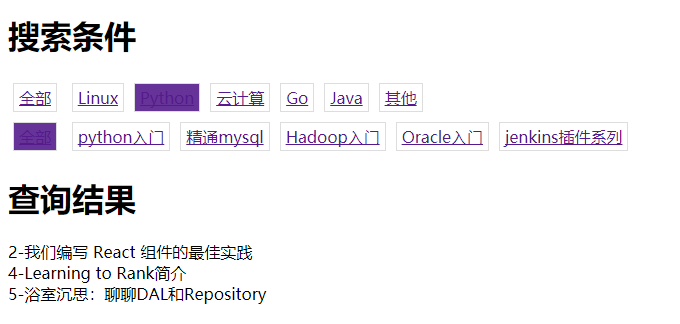
ps附上简图:
四、其他变化
在如上的示例中,我们的过滤条件是从数据库中拿到,有时候我们定义的时候使用的是静态字段,此时组合搜索会稍微修改。
1.model定义
class Article(models.Model):
  title=models.CharField(max_length=64)
  content=models.CharField(max_length=256)
  category=models.ForeignKey(to='Category')
  article_type=(  #使用静态字段放入内存
    (1,'linux'),
    (2,'python'),
    (3,'go'),
  )
2.处理函数变化
###获取####
aritcle_type=models.Article.article_type#直接获取类的静态字段
3.simpletag相应改变
###由于我们传递的元祖,所以取值使用元祖方式
article_type[0]# 筛选条件id
article_type[1]# 筛选条件名称
以上就是本文的全部内容,希望对大家的学习有所帮助,也希望大家多多支持【听图阁-专注于Python设计】。