Python matplotlib绘制饼状图功能示例
本文实例讲述了Python matplotlib绘制饼状图功能。分享给大家供大家参考,具体如下:
一 代码
import numpy as np
import matplotlib.pyplot as plt
#The slices will be ordered and plotted counter-clockwise.
labels ='Frogs','Hogs','Dogs','Logs'
sizes =[15,30,45,10]
colors =['yellowgreen','gold','#FF0000','lightcoral']
#使饼状图中第2片和第4片裂开
explode =(0,0.1,0,0.1)
fig = plt.figure()
ax = fig.gca()
ax.pie(np.random.random(4), explode=explode, labels=labels, colors=colors,
autopct='%1.1f%%', shadow=True, startangle=90,
radius=0.25, center=(0,0), frame=True)
ax.pie(np.random.random(4), explode=explode, labels=labels, colors=colors,
autopct='%1.1f%%', shadow=True, startangle=90,
radius=0.25, center=(1,1), frame=True)
ax.pie(np.random.random(4), explode=explode, labels=labels, colors=colors,
autopct='%1.1f%%', shadow=True, startangle=90,
radius=0.25, center=(0,1), frame=True)
ax.pie(np.random.random(4), explode=explode, labels=labels, colors=colors,
autopct='%1.1f%%', shadow=True, startangle=90,
radius=0.25, center=(1,0), frame=True)
#设置坐标轴刻度
ax.set_xticks([0,1])
ax.set_yticks([0,1])
#设置坐标轴刻度上显示的标签
ax.set_xticklabels(["Sunny","Cloudy"])
ax.set_yticklabels(["Dry","Rainy"])
#设置坐标轴跨度
ax.set_xlim((-0.5,1.5))
ax.set_ylim((-0.5,1.5))
#设置纵横比相等
ax.set_aspect('equal')
plt.show()
二 运行结果
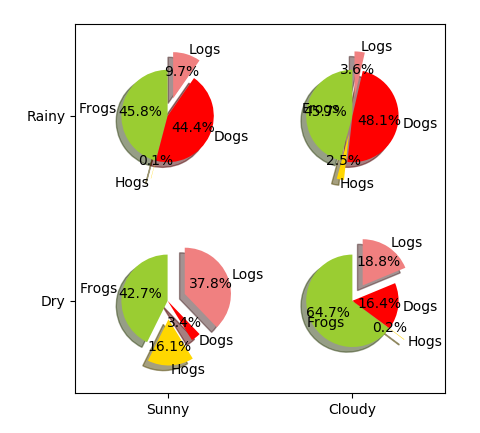
更多关于Python相关内容感兴趣的读者可查看本站专题:《Python数学运算技巧总结》、《Python数据结构与算法教程》、《Python函数使用技巧总结》、《Python字符串操作技巧汇总》及《Python入门与进阶经典教程》
希望本文所述对大家Python程序设计有所帮助。